I have always enjoyed doing what I refer to as conceptual photography, this is where you need to depict a theme, topic, controversial subject or anything you may choose in a photograph. I think this could be used in teaching as it really evokes higher order thinking and personal reflection to link a topic to a photograph. The student would have to think about what the topic means to them, then use their imagination to decide what visual picture can be inspired by the thought. Finally some technical skill is required to produce an image that reflects what is in your minds eye.
This photograph was taken with the view to shock the viewer. The following techniques were used to achieve this; the background of the photograph was dramatised by making it red, the association with red is, pain, danger, beware and it is the colour that the eye is most drawn to after yellow. The second shock tactic was to position the subject in the middle of the photograph. Normally good composition is having the subject on a line of thirds, having the subject in the middle causes the viewer to feel uncomfortable. Words were added that state the obvious leaving nothing to the imagination of the viewer.
Photography is a tool that can be used to teach visual thinking. Visual literacy is fast becoming a very important literacy in the 21st century.
Sunday, 27 March 2011
Friday, 18 March 2011
Painting with Pedagogy
“One's destination is never a place but rather a new way of looking at things.”
Henry Miller
The above quote from Henry Miller is a perfect axiom of what I have learnt so far in ICT. The knowledge that I gained was not all new; I knew what a Wiki was, I had read blogs before, I had read about Pavlov and behaviourism previously. The way in which Wiki’s, blogs and mobile phones could be applied to teaching, and the thought that I, as a teacher, could impart with more than mere knowledge, that I could and will teach my students to think, is a new way of looking at teaching - a liberating thought.
The learning theories that we internalised played a very important role in the reflections in our blogs and thus I would like to spend some time summarising what I concluded on the learning theories from doing all the activities.
When analyzing the activities in the context of the learning theories of behaviorism, constructivism, cognitivism and connectivism it is clear that there are elements of each within all the wiki and blog activities that we did.
Behaviourism, as per Mergel (1998) is “based on observable changes in behavior”. In our activities such observable changes in our behaviour is evident. We created a blog and we participated in wiki activities.
Cognitive learning took place in the way that the course gave us practise in posting our reflections to our blog and participating in various discussions in the Wiki.
The largest part of the learning was in the learning theories of constructivism and connectivism.
The constructivism part of the activities was set in the structured analytical part of the activities where we looked at different readings though a structured analytical tool such as (de Bono) 6 Thinking Hats, PMI and SWOT analysis. The learning was a dynamic process of contracting knowledge within a certain context instead of reading or learning off by heart.
In the social part of the activities, learning was acquired from many different opinions on a particular subject; the wiki space being a dynamic place to apply this type of learning in a very short space of time.
The connectivism lies in the fact that 62 student were using digital means to connect to each other and to the wiki on Learning Theories and mobile phone wiki. When considering some of (Siemens, 2004) Principals of Connectivism:
- · Learning is a process of connecting specialized nodes or information sources.
- · Learning may reside in non-human appliances.
- · Capacity to know more is more critical than what is currently known
- · Nurturing and maintaining connections is needed to facilitate continual learning.
It is clear that we have had elements of connectivism in each of our activities.
When constructing any e-learning activity attention should be paid to the learning theories to ensure that the activity has the elements of the learning theory that will create the results with the students that is intended.
All the learning theories, and the fact that everybody has a different learning style, is brought together by the design of an E-learning framework. The idea of combining Blooms Taxonomy (Clark, 1999) with the Theory of Engagement (Shneiderman & Kearsley, 1999) is pure brilliance. The idea of creating students who are higher order thinkers who are actively, and socially engaged at the same time, is innovative.
Graphic representation of my E-learning Design Framework.
In my practice I shall take these two theories and add to that collaboration on a global level. I would like my students to relate not just to his or her own communities, but also with the world at large. I shall involve specialists in the areas of learning, and particular areas that we are investigating, and have them work with the students in Wiki’s collaborating work. I would also like to see a classroom where we connect with students worldwide; we have so much to learn from each other, starting with our neighbour and reaching out nationally and globally to the other nations and cultures. In this way learning transcends time and space.
I would like each student to understand their strengths and weaknesses in terms of their unique learning profiles. Each student would complete several learning profile questionnaires during the year, which they will share with each other. I believe it assists understanding if a student and the facilitator are aware of what type of learning profile the student is. As an example if you know a student has a strong preference for visual learning I would rather give the student a diagram of the learning as opposed to many words. Profiles are a guide only, students’ profiles do change with different environments, subject of learning, moods and even just over time so care should be taken not to label a student as a certain type of learner, it should be used as an awareness only.
The students will leave school having gained experience and not just the basic 3 R’s but also a broader all-encompassing knowledge. They must be able to prove that they have this experience by presenting a portfolio of projects in which they have donated back to the community and world. In doing so they will have acquired leadership skills, project management skills, problem solving techniques and of course, the ability to procure knowledge that they need at the time that it is required. These skills will be taken with them to the workplace and immediately an employer has an employee that he can deploy into the workforce.
An interesting conclusion that I come to whilst doing these activities, is how suited blogs, wiki’s, and ICTs in general, are to diverse students. The one form of diversity that especially crossed my mind is that of ADHD children. If blogs were used by teachers to post the day’s work and to post a list of homework tasks these children would always have access to it. I am sure, not even the most ADHD child can manage to lose the World Wide Web!
In summary, all that we learnt needs to be connected together like a huge multi facetted Rubik’s cube and then used to effectively fill the empty spaces with wiki’s and blogs to create higher order thinking students. A blog, wiki or any ICT is just an empty space. You, as the facilitator of learning, need to decide how this empty space should be filled and which tools should be used to facilitate learning in which space of ICT. As an example, in our activity we used the PMI tool with a partner to analyse the learning theory articles using the empty space of a wiki and filled it with articles and the learnings from all the students in the course. Just reading the articles without actively participating in the activity of a PMI, would have got us to read the articles and forget what we read a day later. Without proper pedagogy the spaces will remain empty, they may be full of visual clutter but if they don’t somehow challenge and change a student, create more synapses in the students’ brain or give them a skill they can use, there is no point to the space, still nothing meaningful occupying that space.
Graphic representation of filling empty space of ICT with effective and efficient pedagogy
In conclusion, the above observations, learnings and thoughts inspires me to pose the following questions to myself:
How will I ensure that I use a range of ICT together with effective and efficient digital pedagogies to enhance student learning?
How will I ensure that I always do engage my students?
How do I make sure that I am not the one making students leave their interactive mobiles at home?
What methods are there for me to use to assess my proficiency as a facilitator of learning?
References:
Clark, D. R. (1999, June 5). Bloom's Taxonomy of Learning Domains. Retrieved March 10, 2011 from Big Dog & Little Dog's Performance Juxtaposit: http://www.nwlink.com/~donclark/hrd/bloom.html#cognitive
Duffy, P. (2008). Engaging the YouTube Google-Eyed Generation: Strategies for Using Web 2.0 in Teaching and Learning. Electronic Journal e-Learning Volume 6 Issue 2 2008 , (119 - 130).
de Bono, E. (n.d.). Six Thinking Hats®. Retrieved March 15, 2011 from de Bono Thinking Systems: http://www.debonothinkingsystems.com/tools/6hats.htm
Henry Miller. (n.d.). BrainyQuote.com. Retrieved March 16, 2011, from BrainyQuote.com Web site: http://www.brainyquote.com/quotes/quotes/h/henrymille133854.html
Mergel, B. (2008, May). Instructional Design & Learning Theory. Retrieved March 12, 2011 from http://www.usask.ca/education/coursework/802papers/mergel/brenda.htm#The%20Basics%20of%20Behaviorism
Shneiderman, B., & Kearsley, G. (1999, May 4). Engagement Theory: A framework for technology-based teaching and learning. Retrieved March 9, 2011 from Sprynet.com: http://home.sprynet.com/~gkearsley/engage.htm
Siemens, G. (2004, December 12). Connectivism. Retrieved March 12, 2011 from Elearnspace everything elearning: http://www.elearnspace.org/Articles/connectivism.htm
Comments
An excellent reflective blog Heleen. Your reflections clearly indicate your participation in the activities. You have explored links between connectivism, multiple intelligences and learning styles, which provide you with a richer and stronger background knowledge of e-Learning design. In your conclusion you drew together the core ideas of scaffolding, and identified how appropriate scaffolds are designed to support higher order thinking as a “thinking routine” that is recognisable by students and transferrable to other situations. Your blog reflections were academically referenced, and your conclusion was well structured, paragraphed and referenced in consistent academic style.
Tutor: Robyn Petersen Date: 28 March 2011.
Monday, 14 March 2011
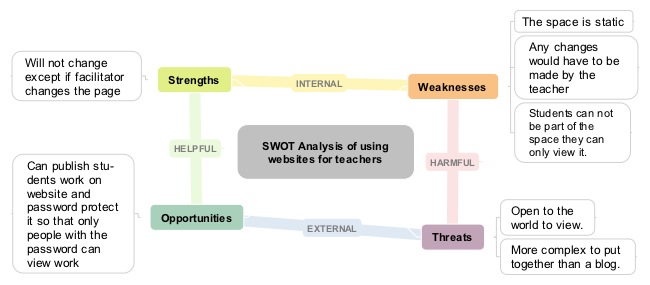
Swot Analysis of Websites for teaching
I have spent the last two hours creating a very basic website. The speed at which one can do this is amazing. You can see my website by following this link http://heleendoesteaching.weebly.com/index.html.
Wiki - the Learning Poential
I have created a wiki please click HERE to follow wiki. The wiki is an analysis of wiki in teaching using De Bono's six thinking Hats (de Bono).
Can wiki's be used to transform student learning
From my analysis on wiki I conclude that using a Wiki in teaching business and maths has potential. In mathematics and business I would like to see wiki's used to support learning in the following ways:
of collaboration by means of technology to augment education and research (Augar, Raitman, &
Zhou, 2004).
References
Augar, N., Raitman, R. & Zhou, W. (2004). Teaching and learning online with wikis. Proceedings of the
21st Australasian Society for Computers in Learning in Tertiary Education (ASCILITE) Conference,
Perth: December 5-8, 95-104. Retrieved 14 April from
http://www.ascilite.org.au/conferences/perth04/procs/pdf/augar.pdf
Can wiki's be used to transform student learning
From my analysis on wiki I conclude that using a Wiki in teaching business and maths has potential. In mathematics and business I would like to see wiki's used to support learning in the following ways:
- Home assignments can be done collaboratively on the Internet, with the wiki serving as an online documentation of the groups work, I would check work and progress and assist if necessary.
- Students can discuss and work on key mathematical concepts with children from all over the world. I would have a mathematical concept and have the children each write ideas and research of where this concept is applied in the world. There may be a vast difference in ideas of the use of statistics in Africa to Australia. Children in Africa may use statistics to investigate how many goats they loose to the local Lion. Children in Queensland may use statistical data to establish whether the river will rise to a level that may flood their homes.
- Wiki can be used to do analysis of business terminology, ie a PMI on each of the different legal business entities that are avoidable to start a new business. The could even request an auditor from an audit firm to assist with their ideas and practical experience.
- A wiki can be used as a presentation tool in place of conventional software, and students
are able to directly comment on and revise the presentation content. (Parker & Chao, 2007)
of collaboration by means of technology to augment education and research (Augar, Raitman, &
Zhou, 2004).
References
Augar, N., Raitman, R. & Zhou, W. (2004). Teaching and learning online with wikis. Proceedings of the
21st Australasian Society for Computers in Learning in Tertiary Education (ASCILITE) Conference,
Perth: December 5-8, 95-104. Retrieved 14 April from
http://www.ascilite.org.au/conferences/perth04/procs/pdf/augar.pdf
Parker, K. R., & Chao, J. T. (2007). Wiki as a Teaching Tool. Interdisciplinary Journal of Knowledge and Learning Objects , 3, 67.
The Potential of Blogs
I have done a PMI analysis of the potential of using blogs in the teaching context. It is very clear that we should be using blogs in teaching as I could not come up with many minus thoughts on the subject. Although I do wish to make clear that a blog can not replace effective teaching. It is in my opinion only a pedagogical tool to be used effectively along with other tools and techniques.
How would I apply using a blog in teaching Maths and Business
I would use blogs in the following ways to enhance and support my students learning and in some cases my own learning;
References
Plus | Minus | Interesting |
+ Very easy to set up. + Students can access blog at any time. + Facilitator can provide students with links to more learning’s. + Can facilitate learning for diverse students – with revision of days work, extra resources if deeper understanding is required. More info for gifted students. + Students can comment on each others work + Because a posting can only be changed by the author is has some sort of permanency + Students can keep a journal of their learning + Care givers can see what students are busy with + Critical reflections can be done + Will improve student’s writing skills as they are writing for the WWW and not just for a teacher. | - Not all students have access to computer at home. - Some students may have privacy issues. | ? Why do I not see this been used at schools? |
How would I apply using a blog in teaching Maths and Business
I would use blogs in the following ways to enhance and support my students learning and in some cases my own learning;
- Reflections - entice students to reflect and keep dairies of their learning on their own blogs.
- To post class information such as homework, timetables, assignments, events and topics for the week or month. Not only can the students review information here but parents can get an idea what their children are busy with.
- Post work that has been exceptional for all to gain experience from, of course with the students permission.
- Have links to more in depth studies of the topics currently being studied in both Maths and science for those students that feel they would like to extend themselves.
- Explanation of the daily work being done for students that are struggling to understand a topic.
- Post photo's of outings or fun activities that were done in the classroom.
References
Duffy, P. (2008). Engaging the YouTube Google-Eyed Generation: Strategies for Using Web 2.0 in Teaching and Learning. Electronic Journal e-Learning Volume 6 Issue 2 2008 , (119 - 130).
Saturday, 12 March 2011
180° - The Mobile Wiki
Mobile Wiki in the context of learning theories
When analyzing the Mobile wiki in the context of the learning theories of behaviorism, constructivism, cognitivism and connecivism it is clear that there are elements of each within this learning but I found the activity to be mainly connectivism and constructivism. The constructivism part of the activity being the six thinking hats which allowed us to analyse and collaborate on a topic which we would normal respond to in one sentence. The connectivism lies in the WIKI part of the activity, learning from many different opinions to one subject. My graphical interpretation of the activity in terms of the learning theories is as follows:
Personal participation
On personal reflection I come to one huge conclusion – I am a hypocrite. I have not been in favour of my children having mobile phones and did not advocate mobiles been allowed to be taken to school. I read the articles for this exercise and my viewpoint did a 180-degree turn. For the first time I thought about how mobiles can be used in schools in a positive manner. The opportunities excited me as I have been in the poorest areas in Africa and the contrast that I have often pointed out is that of children running in the streets with no x-box, no computers, no classrooms, no text books but most of them seem to have a mobile. This must be utilized to bring these children into the world of technology. Is there somebody doing this? And if so can I help? These two thoughts immediately popped into my head and I will research this further. I was blind but now I see comes to mind.
As far as De Bono and his six thinking hats I had ironically given a creative thinking presentation in Czech Republic years ago illustrating this technique and how it can be used in Lean manufacturing implementations. Which brings me to my next point – by using techniques like these we send our students into the working world with tools that they can use to the benefit of their employers. I find the fact that tools that I have learnt in the business world can also be used with students very exciting and I will ensure that my students leave my class having used these analyzing techniques and know how they can be used in their workplaces.
Swot analysis of mobile wiki
The main contribution to a students learning of doing a activity like this is that an activity like this moves a student into the higher order thinking of blooms taxonomy.
In conclusion as Karen Stephenson states:
“Experience has long been considered the best teacher of knowledge. Since we cannot experience everything, other people’s experiences, and hence other people, become the surrogate for knowledge. ‘I store my knowledge in my friends’ is an axiom for collecting knowledge through collecting people (undated).”
References:
Stephenson, K., (Internal Communication, no. 36) What Knowledge Tears Apart, Networks Make Whole. Retrieved March 12, 2011, from http://www.netform.com/html/icf.pdf.
Siemens, G. (2004, December 12). Connectivism. Retrieved March 12, 2011, from Elearnspace everything elearning: http://www.elearnspace.org/Articles/connectivism.htm
Thursday, 10 March 2011
E-Learning Framework
MY E-Learning Framework
In the design of my E-learning framework I have used a combination of Blooms Taxonomy and Engagement Theory. Blooms taxonomy is the building block to get the student from zero to hero, zero being no knowledge or understanding of the subject and hero being able to create new ideas in relation to the subject.
At each level of learning the student will relate, create and donate. Relate being with the student’s peers, community and the global world using the most effective ICT to further the learning. Create will involve the students creating their own learning paradigm and then donating the learning to the community.
In my E-learning framework huge emphasis will be given to the global community, at each level of learning attention should be given to collaborative learning in the global community though the use of effective ICT’s.
Though the method of students relating, creating and donating evaluation will take place. As an example students may be asked to design a brochure for a company needing to promote their business. Evaluation will take place by an actual company giving feedback on the brochure.
I believe that this framework will create students who process essential workplace skills such as teamwork, leadership, problem solving, collaboration of ideas in the global community and project management. The student will also already have proof from projects that they have implemented into the community of these abilities.
References
Clark, D. R. (1999, June 5). Bloom's Taxonomy of Learning Domains. Retrieved March 10, 2011, from Big Dog & Little Dog's Performance Juxtaposit: http://www.nwlink.com/~donclark/hrd/bloom.html#cognitive
Shneiderman, B., & Kearsley, G. (1999, May 4). Engagement Theory: A framework for technology-based teaching and learning. Retrieved March 9, 2011, from Sprynet.com: http://home.sprynet.com/~gkearsley/engage.htm
Subscribe to:
Posts (Atom)